There are some moments when I hear my worldly wise 37 year old self giving advice to others. Over breakfast in my Saigon hostel, I was talking to Joanne, a south east London, sparky red head who is volunteering in an orphanage in the city. Our conversation was brief but in just those few minutes I was touched by her reflections.
'You should write them down,' I told her.
'And don't do that thing where you think, to yourself "oh I haven't written for ages so it's going to take such a long time for me to explain everything". You should just start writing'. As I heard myself saying these words I realised they were words more for my own ears. And so, I write.
The original plan for south east Asia was to cycle from Bangkok to Ho Chi Minh. Not only am I flying - one environmental extreme to the other - but two weeks ago I posted my bicycle home in a box, along with all four panniers, cycling shorts and tent. I now have a small ruck sack and am sporting brown hippy trousers and yellow flip flops. I have dyed my hair back to brown and the only remnant of my former cycling self is the bicycle on the front of my T shirt. I am, as usual, struggling with this latest transition but traveling with a bike, rather than on a bike was becoming ridiculous.
A mixture of emotions motivated and follow this decision. On the one hand I feel a bit of a fraud. The whole trip was supposed to be about cycling the world. That was what made it different. I didn't want to do the same as millions of other 'travellers' and follow a well worn path from bus to hostel. If you feel let down by my decision to ditch the wheels, then I am sorry. Cycling for me has always been a more sensible way to travel to see the corners of countries and to meet people. Here though, where language is a barrier I decided it would just not be fun by myself in a small village trying to communicate with the locals and having no one who could share the experience. When I was cycling 60 miles a day crossing the States I always worried how I would sustain this level of fitnes. No bike means I have to seek out exercise but that can be fun in itself. One of my favourite moments in Vietnam so far has been joining in with a free open air aerobics class. A hundred Vietnamese women and me. Loved it. Why don't we do organise that in London?
Back to breakfast and Joanne. She told me about the children in the orphanage. Many are physically disabled, victims of the ongoing legacy of Agent Orange. The US dropped 20 million gallons of herbicide, 60% of which was Agent Orange in the Vietnam War between 1961 and 1971. The toxic chemical was dropped in attempt to defoliate the trees so the Communist Viet Con could not hide in the forests. The effects on both the environment and the people however were catastrophic, particularly in terms of long term effects on children. And the Viet Cobg dug a network of tunnels where whole villages sheltered underground. The museum in Ho Chi Minh showed some pretty horrific images of deformities including two Siamese twins, their foetus preserved in formaldehyde. The museum was certainly very one sided. Hardly surprising in the city whose name reminds everyone that the north won the war. There have since been many lawsuits by both American soldiers and Vietnamese victims trying to get American chemical companies to take the blame. Even at the time American students staged sit ins to try and prevent companies including Dow and Monsanto from recruiting on campus.
Jo said that there are also many babies who are abandoned, either at the hospital or on the doorstep of the orphanage. Although it is well staffed many of those who work there seem desensitised to their role, though they are the main carers for these children. She has suggested to the management that perhaps the staff themselves need some love, care and attention. She suggested they could run a day where they could bring their own children in, once a month for activities with the volunteers. She said she walks into the place every day and the children stretch their arms out from their beds hoping for a hug. She gives as many as she can. She may work there for six weeks and has thought a lot about the impact she can or can't make in that time. With an overwhelming situation she has resolved to make sure she just gives everything she can to each interaction.
Last week she picked up and cuddled a baby whose cry was particularly strong. The other staff told her he had just arrived having been abandoned on the door step. On his leg written in pen was his name - Kwe. She speculated on how the baby's life would change if she were to look after it, checking adoption laws and loop holes. I shared my idea about super powers. That everyone has a super power to change and influence the world around them through the people they meet. She quoted Gandhi. 'Be the change you want to see in the world'.
This and other recent conversations have strengthened my passion for education and schools. Also talking very proudly about my old school has reminded me how much a group of committed individuals can achieve if they all work together. In Hoi An, I ate in a restaurant run by the Blue Dragon foundation. Their work helps children get where they should be -with their families, in education or training. They have rescued 268 trafficked children. Some were taken to China for prostitution and others to work in garment factories in Ho Chi Minh. The charity was started by an Australian, Michael Brosowski who was teaching English at the university of Hanoi. One day he was supposed to be climbing a mountain on a tour but because his feet were hurting he stayed at the bottom. He was approached by two Vietnamese boys who wanted help with their English homework. He ended up teaching street children - shoe shine boys - English and along with a Vietnamese university student organised football games for them. Within 2 years he had quit his job to develop the charity full time. Reading the stories of these children reminded me of the gulf between tourism and the country you don't see. I hope to visit their centre in Hanoi and learn more about their work.
Vietnam is according to the World Bank, 129th out of 180 countries in terms of wealth. However it is 18th in terms of online access and the fastest growing number of Facebookers. It is aiming to be a developed country by 2020. However there is only one party in Vietnam and criticism is not tolerated. The government has recently taken a harder line on those who suggest freedom of the press or a multi party democracy. Five prominent bloggers, founding members of the Club for Free Journalists have just been sentenced to 13 years imprisonment. Another was forcibly admitted to a mental health institution and 22 activists were jailed for subversion and sentenced to between 10 years and life imprisonment. The mother of one of the bloggers self immolated in protest last summer. This was not reported in Vietnam.
Before arriving in Vietnam I spent 6 great weeks in Thailand. Those of you keeping up with the story know that my own Internet and online activity decreased substantially when I was travelling with Javier, the Spaniard. After Chiang Mai, we (one teacher, one chef, one bike) made our way slowly back to Bangkok by train. We stopped at Lampang which had a thriving night market and a swanky guest house with a family of cockroaches living in the plug hole of the sink. Eww. We saw the temples at Sukhothai, ate its famous noodles and for the last time, I cycled. Peddling amongst the ancient buildings was a suitable spiritual end to the bike part of the journey. After another stop in buzzing Bangkok and a rather long journey via Ranong, where I had to briefly stop to go to Myanmar to extend my visa, we reached the island famous for its Full Moon Party - Koh Phagnam.
Koh Phagnam was a relaxing spot to spend a week and the non party side of the island was lovely. The island has an odd patern because every month 20,000 people descend on it for the Full Moon Party. On the north of the island we stayed in Chaloklum. Each night fisher men would take the squid boats out to sea with their eerie green lights, then the next day groups of women would clean thousands of squid near the beach with the fishy juices running back into the sea and then carefully splay them on racks near the beach. They are dried out for a popular Thai snack.
Back in Bangkok Javier and I spent our last few days together. We went to the biggest market in Asia, back to the restaurant which apparently serves the best Pad Thai in Thailand - wrapped in an omelette and went to the post office and sent the bike home in a big box. We said goodbye late at night in a busy Bangkok street and I walked away feeling very sad. Funny how you can feel most alone when you are surrounded by hundreds of people.
But the trip goes on.
Frequent stays at hostels and eating establishments and hanging out with a café owner, have also made me think about what it takes to run a good organisation. Like a good school you can tell whether a place is loved the minute you walk in. If management care, staff care about customers and understand what they want. That comes through in every tiny interaction from the greeting, to the cleanliness of a place to the food.
I signed up for another cooking class in Hoi An. A pretty town on a river and close to the coast in the middle of Vietnam. Cars and motorbikes are banned and all shops have to hang pretty lanterns from their frontage. The cooking operation was run by Ms Vy. An impressive 40 year old woman who started cooking aged 10 and opened her first restaurant in Hoi An in 1992. She visited Melbourne soon after, a trip which opened her eyes to the west and what tourists were looking for. She now runs five restaurants in town incuding a bakery where westerners flock for a cappucino and croissant.
She told us about how Vietnam had rationing for 40 years so many people lost their cooking skills. The government one Christmas gave everyone a packet of MSG - Monosodium glutamate. Add a bit to water and you almost have stock. She also told us how in Vietnam it is the women who work and that was certainly born out by what I saw. Shops, restaurants and markets were run by women. Ms Vy explained her mother's view 'the beauty of a woman is from her work, her speech and her morality, not how pretty and made up she looks'. On a motorbike tour around the area it was also the women I saw working in the paddy fields, tending, harvesting and sorting crops. Fishing seemed to be for the men along with taxi driving and sitting in front of the telly. Not only is she running successful restaurants but she has taken on the bigger cause of promoting Vietnamese cuisine to the rest of the world. Just one woman, seeing the bigger picture and using her super power to make a difference.
Hoi An is also famous for its tailoring and although this has become a huge tourist attraction it was still a great experience to have a suit made. Odd though to be putting on a suit in the steamy heat with sweat dripping off my nose. The Vietnamese don't seem half so hot and sticky and look with amusement at us moist foreigners. So much so in fact that in one restaurant the owner rather inappropriately started wiping the hot face of my friend Sarah whilst her colleague joined in the mission by fanning her enthusiastically. The shop which made my suit was run by a family. I went back for my fitting were in the middle of eating lunch. I was, or course, invited to join and in a very Welsh manner was strongly encouraged to eat several delicious, freshly fried banana pancakes.
I have met lots more travellers since the bike and Javier went home. When I began this trip I was keen to avoid the 'Gap Ya' scene. Having taught for 10 years, many of these students were only 8 when I started teaching. Yes, I did meet a girl who liked pheasant shooting and who was pleased that she was going to be able to take her pony to university. She also defined herself as working class. I momentarily struggled with my own prejudices.
There is something however about people who choose to travel - especially on their own. I definitely wouldn't have had the guts to do it when I was Ellen's age or even when I began this trip. Ellen is taking a year out of Oxford University and is contemplating whether it is the place for her. After Vietnam she is heading to China. You go girl - but be careful!
I am on my way to Hanoi where I will go on a trip with Sarah a South African girl I met. She has already done wonders to combat my prejudices of white South Africans and I have enjoyed learning about how the country has changed since apartheid. She said how the richer areas remain gated but there is a growing black middle class moving in to these areas. I also learned a bit about the development of political parties as the ANC and the Democratic Alliance both try and appeal beyond their traditional supporters who were divided by skin colour. Once again it is still good to be reminded we are only one people and despite the differences in culture, language, custom or religion it only takes a smile, an exchange or gesture to make a connection.
Talking with many other travellers, I have enjoyed discussing unusual and sometimes controversial topics. The first traveller question is always, 'Where are you from?'. A potentially complex question. I met Dario for example who lived in Switerland, grew up in Spain and whose father was from Sierra Leone. We had a really interesting discussion about identity, how much is set by society and how much is self defined. Will people ever answer,
'I am a citizen of the world my friend'.
Yes, a world citizen. Unless Wales is playing rugby, then I'm Welsh. I am never English. Few non English speakers seems to recognise the word British. But now I feel more strongly connected to London and feel fiercely proud of our hip, cosmopolitan capital. I also feel more European since being in Asia.
On my first day in Vietnam I took up the offer of going to a water park with two fellow Europeans, a Swiss and two Dutch guys. Scary water slides with no reference to health and safety procedures are not normally my thing but I knew I would squeeze in a swim so said 'yes, great'. I went with Chris, the Swiss and Élon the Dutch one. Chris was a teacher in a pupil referral unit, a kite surfer, with an extensive history of drug experimentation and a tendency to be super, almost obsessively clean. He told me that when he has a party in his house he puts a notice up in his bathroom to tell men sit down when they wee. Finally a man who agrees men do not have good aim. Élon, the Dutch guy runs a family business in Amsterdam near the Reich Museum selling reproductions of old masters. VanGough's sunflowers, that sort of thing. They are painted in China with oil paints in brighter colours because that is what people like. Elon must also be credited for teaching me to cross the roads of Ho Chi Minh and helping me relax in the metropolis rather than expecting to be be mugged at every moment. Also met three British guys (John, Marcus and Kane) who looked after me in Ho Chi Minh. Had a great night out watching Wales beat England in the rugby 30 - 3. Met a couple from north Wales, she was also called Gwenllian. Special thank you to John that night for walking me home when his friends were ready for the night club. He said 'It's what I'd want someone to do for my sister'. Really kind. I also feel very lucky to speak English which is used almost exclusively as the language of travel.
Already it has been an amazing eight months. I think I will be heading back to London in June but nothing fixed yet. As the end of my adventure slowly approaches I want to make the most of it and although I may not be biking any more, I am still talking and learning.
Two teachers who have given up our jobs to take two bikes on a year's adventure around the globe. We plan to stay with friends of friends, visit schools, keep pedalling and raise money for schools in Africa and teachers in the UK. Follow our journey.
Friday, 22 March 2013
Wednesday, 20 February 2013
Trade, food and love
A delayed Thai train. A perfect opportunity for catching up with some blog writing. Sitting on a bench on Chiang Mai platform gleaning tit bits of information from the Chinese girl who is good at asking officials when we might leave.
It can be difficult to keep up with someone else's travels. In the last six weeks, since leaving Australia I have been around a bit so just to save any confusion - a summary:
I spent the second two weeks of January on the island of Borneo. My bike stayed in its box. The island is made up of three countries: Brunei, Malaysia and Indonesia. I stayed in Brunei and visited Sabah, in Malaysia. I then flew to Thailand and have been here almost a month. I have cycled for a few days. My decision to slow the trip down has led to less cycling, more trains and buses, less blog writing, a greater appreciation of Thai food, its markets and restaurants and spending time with some lovely people. I have come to the conclusion that three of the most important things that bring the world together are trade, food and love.
Brunei is a small oil rich country of 400,000 ruled by the Sultan. I stayed there with my friend Hilary who is a maths teacher at the international school. She and her husband Tony provided a home from home. Brunei is an interesting country. An oil rich dictatorship, the Sultan rules by decree. Until 1986 the country was a British protectorate. On the one hand Bruneians, as long as they are ethnic Malays, enjoy one of the highest standards of living in the world. They pay no taxes, have subsidised cars with very cheap petrol - people do not walk in Brunei - everyone drives on the highways that criss cross the country. People are also well looked after with state pensions. I met a group of Bruneian students on a day trip to the jungle. The students were sixth formers studying travel and tourism. Many of them planned to go to British universities, paid for by the Bruneian government before coming back to work in the oil industry. My friend Jaime's dad benefited from a similar programme though when he went to Britain he was not obliged to come back to Brunei.
I was interested in the nature of the dictatorship. It is certainly a strict Muslim country. You are expected to dress discreetly, no alcohol is allowed. Although you can bring in two bottles of wine and 24 beers every 24 hours so there is a culture of booze cruises amongst the expats. Recent decrees include no dancing and nothing is allowed to open between 12 and 2 on a Friday. Hilary and I were also surprised to read in the museum that circumcision is considered 'noble' for a woman. Baby girls are circumcised at 40 days. Female genital mutilation is defended by many and though not as extreme as the type performed in some parts of east Africa still a horrible practice, though done with good intention.
This traditional, family orientated and conservative culture means expats and rich Bruneians live a very separate life. I spent an afternoon lazing around the pool at the Empire Club. An opulent palace built by the Sultan's brother Jefri - the former finance minister - with public cash. Eventually a scandal meant the Sultan had to sack Jefri who avoided prosecution by turning over all his weath to the state. Even in a dictatorship the public have limits. Another interesting part of the expat life is the hash. A legacy of empire, the hash involves men running through the jungle, following a paper trail and ending of course with many beers. So very British.
Malaysian Borneo was quite a contrast from Brunei. I took a ferry to the island of Labuan and then another to KotaKinabalu. Here I met up with friends Xenia and Grace who just happened to be there at the same time. I also met Clare Cave. We had a great time travelling over the next week together in Malaysia. I use Claire's surname because she is a singer songwriter and has just released her first EP - In all good record shops (well on iTunes) now!
For my 10 days in Malaysia I felt I had joined the back packer circuit. This is where people come to climb mount Kinabalu, see Orangutangs, dive with turtles and treck in the leechy jungles. In one hostel I met Danny the German and Nico and Natalie. Nico was Australian and was cycling. Nico had for a long time been on a diet of only raw foods. I learned a lot about Malaysian fruit. The infamous sick smelling Durian may be the king but mangosteen is the queen with a regal purple exterior amd a small green crown, the fruit has a lychee, sweet and soft inside. Natalie his girlfriend was from Denmark and was training as a sex therapist. She said she helped people to 'first love themselves' but unlike some practioners was not one for practical therapies. A fruit expert and sexologist. What a combination.
Britain's Empire on Borneo grew through the trade of hard wood and rubber. Using elephants and Indian workers the British trading companies thrived. It is now palm oil plantations which dominate the landscape and threaten the rain forest and its inhabitants including Orangutans and the famous big nosed Proboscis monkeys. Despite quite a few tourists and its British history walking down the street or trying to communicate often generated much giggling from the local people. This took some getting used to but felt very adventurous even without the bike.
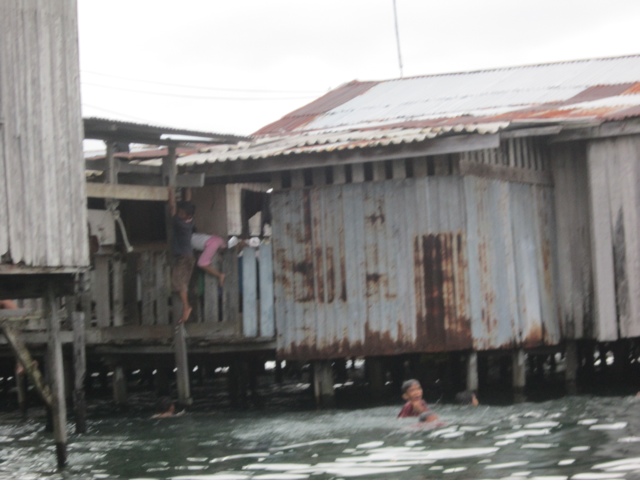
After a few days in the coastal town of Sandakan, Claire, Grace and a German (Danny) headed to a little island called Mabah. Close to Sipadan - a diver's Mecca. No one is allowed to stay on Sipadan. In fact you need a permit to snorkel or dive there. Only a handful can go daily and the permits get booked out months in advance. We stayed in a really friendly, very basic place in the water village. Most of the people on the island were originally from the Philippines. People have moved here for a better life. Tourists bring with them a lot of cash. Trade moves money around.
Aside from a sleepless night caused by a rat in our dorm attracted by the two tiny bananas I had squirrelled away in my bag, the bed bugs that feasted on me for two nights and the trigger fish attack that left a fellow snorkeler with a bleeding toe - Mabul was a fun few days. Our last night ended dancing on the beach with a group of work chums from Kuala Lumpur and a glamourous group of lady boys under an almost full moon. A moment from the road I will try never to forget.
Thailand escaped Empire and has therefore a unique culture combination of vibrant and tolerant that has seduced so many Westerners. In Thailand people consider that women are more intelligent than men. Friends who are looking to adopt here told me adopting a Thai baby girl is apparently close to impossible.
Bangkok was high tech, buzzing and glitzy. Much cleaner and more modern than I was expecting. In Bangkok I stayed with Steph who is another teacher in an international school and her partner James. Once again it was great to see a place through the eyes of someone who lives there. Steph took me to her local floating market. Hardly any tourists and amazing food. I tried little fried quails eggs with soy sauce, green pancakes with candy floss filling and scallops still in their shells. Buying food at local markets is what made me think about the power of trade to bring people together. Both buyer and seller benefit and despite little or no language skills a small connection is made.
Inspired by Thai food, I signed up for two Thai cooking courses. The first was with a lovely lady called Poo whose cooking school in her own community in the Bangkok slums had been financed with a loan from an Australian charity that provides micro loans to fledging businesses. An inspiring woman with a teenage son and on her second marriage she was the brains and the graft behind the slick operation that had kept is soul and brought cash to her own community.
From Bangkok I went north, with still not on the bike. The night train to Chiang Mai was an experience and a half. I had to buy a first class ticket - I had a room to myself. I quickly got to know my neighbours - Tony who had moved from the States to live in Thailand and a Canadian couple on holiday. I convinced my new friends to walk through the train - through staff compartments and sparking tracks to the restaurant car. Opening the door to this carriage was like opening the door to a secret club. Hit by the muggy breeze from the open windows - no air conditioning here, chincy Fairy lights, music videos and the loud buzz of conversation over the roar of the train. I joined Beatrice, a 59 year old artist from France and 20 something Augustine from Argentina for a beer. The night took a more surreal turn when a Thai police officer glugging rum with the best of them joined the group. What a night. And if I hadn't met Beatrice then perhaps I would not have been in the same restaurant as 'Javier', the Spanish cafe owner.
After a few days of coffees, markets and more amazing street food in Chiang Mai I decided it was time to get back on the bike and take on some of Thailand's mountains. The fact that Javier was staying in Pai was purely coincidence.
The ride would take two days. Easy enough I thought to myself.
The road out of Chiang Mai was flat. Easy cycling. And then I turned off to Pai and soon the hills began. Time to stop for a coffee. I probably, as usual, spent too long drinking coffee and didn't realise how soon it would get dark. The hill was incredibly steep and showed no sign of ending. I asked two fruit sellers how far to my intended stop and they said it was far. One tried to get on the back of my bike and I realised he was a bit the drunk side. I stopped at the next place advertising coffee and asked if they knew of any guest house. Owner, Chuchai said I could stay over the road in someone's house. He went to ask the man and he said his wife would be back at 7pm so I could come them. So far so good.
Chuchai then cooked me Chinese duck dinner and cracked open a special box of banana cakes he'd bought in Japan. Seven came and went but no sign of the lady opposite. Chuchai said that when his wife came home I could stay in their house. Everything was getting a bit strange. Eventually his wife came home with another man and two younger females. I slept on the sofa - one of five sleeping in the same room. After sampling one of Chuchai's perfectly timed 25 second espressos (he learnt how on google) I was back on the road to cycle the remaining rather tough 66 kilometres.
Pai is a small hippy town that turned into an even bigger attraction when two Thai rom coms were set here. It is on the backpacker trail so the local pool is awash with tattoo branded 20 somethings. There is also a well established artistic community comprised of Thai artists, musicians and a fair number of older American hippies who have moved here for the low cost of living. Others are drawn by the authorities relaxed approach to cannabis. In fact doing nothing in Pai has become a catch phrase for the place.
After several days of doing not much in Pai, apart from finding a regular breakfast spot, recognising and greeting the locals, swimming in two diifferent pools and eating some beautiful banana pancakes to celebrate pancake day I headed back to Chiang Mai. This time though on the back of a motor bike. Those 742 curves were so much easier with petrol.
One teacher, one chef, one bike, one moped ... who knows where the journey takes me next. Trade? Food? Or ...?
Http://twoteacherstwobikesoneworld.blogspot.com
It can be difficult to keep up with someone else's travels. In the last six weeks, since leaving Australia I have been around a bit so just to save any confusion - a summary:
I spent the second two weeks of January on the island of Borneo. My bike stayed in its box. The island is made up of three countries: Brunei, Malaysia and Indonesia. I stayed in Brunei and visited Sabah, in Malaysia. I then flew to Thailand and have been here almost a month. I have cycled for a few days. My decision to slow the trip down has led to less cycling, more trains and buses, less blog writing, a greater appreciation of Thai food, its markets and restaurants and spending time with some lovely people. I have come to the conclusion that three of the most important things that bring the world together are trade, food and love.
Brunei is a small oil rich country of 400,000 ruled by the Sultan. I stayed there with my friend Hilary who is a maths teacher at the international school. She and her husband Tony provided a home from home. Brunei is an interesting country. An oil rich dictatorship, the Sultan rules by decree. Until 1986 the country was a British protectorate. On the one hand Bruneians, as long as they are ethnic Malays, enjoy one of the highest standards of living in the world. They pay no taxes, have subsidised cars with very cheap petrol - people do not walk in Brunei - everyone drives on the highways that criss cross the country. People are also well looked after with state pensions. I met a group of Bruneian students on a day trip to the jungle. The students were sixth formers studying travel and tourism. Many of them planned to go to British universities, paid for by the Bruneian government before coming back to work in the oil industry. My friend Jaime's dad benefited from a similar programme though when he went to Britain he was not obliged to come back to Brunei.
I was interested in the nature of the dictatorship. It is certainly a strict Muslim country. You are expected to dress discreetly, no alcohol is allowed. Although you can bring in two bottles of wine and 24 beers every 24 hours so there is a culture of booze cruises amongst the expats. Recent decrees include no dancing and nothing is allowed to open between 12 and 2 on a Friday. Hilary and I were also surprised to read in the museum that circumcision is considered 'noble' for a woman. Baby girls are circumcised at 40 days. Female genital mutilation is defended by many and though not as extreme as the type performed in some parts of east Africa still a horrible practice, though done with good intention.
This traditional, family orientated and conservative culture means expats and rich Bruneians live a very separate life. I spent an afternoon lazing around the pool at the Empire Club. An opulent palace built by the Sultan's brother Jefri - the former finance minister - with public cash. Eventually a scandal meant the Sultan had to sack Jefri who avoided prosecution by turning over all his weath to the state. Even in a dictatorship the public have limits. Another interesting part of the expat life is the hash. A legacy of empire, the hash involves men running through the jungle, following a paper trail and ending of course with many beers. So very British.
Malaysian Borneo was quite a contrast from Brunei. I took a ferry to the island of Labuan and then another to KotaKinabalu. Here I met up with friends Xenia and Grace who just happened to be there at the same time. I also met Clare Cave. We had a great time travelling over the next week together in Malaysia. I use Claire's surname because she is a singer songwriter and has just released her first EP - In all good record shops (well on iTunes) now!
For my 10 days in Malaysia I felt I had joined the back packer circuit. This is where people come to climb mount Kinabalu, see Orangutangs, dive with turtles and treck in the leechy jungles. In one hostel I met Danny the German and Nico and Natalie. Nico was Australian and was cycling. Nico had for a long time been on a diet of only raw foods. I learned a lot about Malaysian fruit. The infamous sick smelling Durian may be the king but mangosteen is the queen with a regal purple exterior amd a small green crown, the fruit has a lychee, sweet and soft inside. Natalie his girlfriend was from Denmark and was training as a sex therapist. She said she helped people to 'first love themselves' but unlike some practioners was not one for practical therapies. A fruit expert and sexologist. What a combination.
Britain's Empire on Borneo grew through the trade of hard wood and rubber. Using elephants and Indian workers the British trading companies thrived. It is now palm oil plantations which dominate the landscape and threaten the rain forest and its inhabitants including Orangutans and the famous big nosed Proboscis monkeys. Despite quite a few tourists and its British history walking down the street or trying to communicate often generated much giggling from the local people. This took some getting used to but felt very adventurous even without the bike.
After a few days in the coastal town of Sandakan, Claire, Grace and a German (Danny) headed to a little island called Mabah. Close to Sipadan - a diver's Mecca. No one is allowed to stay on Sipadan. In fact you need a permit to snorkel or dive there. Only a handful can go daily and the permits get booked out months in advance. We stayed in a really friendly, very basic place in the water village. Most of the people on the island were originally from the Philippines. People have moved here for a better life. Tourists bring with them a lot of cash. Trade moves money around.
Aside from a sleepless night caused by a rat in our dorm attracted by the two tiny bananas I had squirrelled away in my bag, the bed bugs that feasted on me for two nights and the trigger fish attack that left a fellow snorkeler with a bleeding toe - Mabul was a fun few days. Our last night ended dancing on the beach with a group of work chums from Kuala Lumpur and a glamourous group of lady boys under an almost full moon. A moment from the road I will try never to forget.
Thailand escaped Empire and has therefore a unique culture combination of vibrant and tolerant that has seduced so many Westerners. In Thailand people consider that women are more intelligent than men. Friends who are looking to adopt here told me adopting a Thai baby girl is apparently close to impossible.
Bangkok was high tech, buzzing and glitzy. Much cleaner and more modern than I was expecting. In Bangkok I stayed with Steph who is another teacher in an international school and her partner James. Once again it was great to see a place through the eyes of someone who lives there. Steph took me to her local floating market. Hardly any tourists and amazing food. I tried little fried quails eggs with soy sauce, green pancakes with candy floss filling and scallops still in their shells. Buying food at local markets is what made me think about the power of trade to bring people together. Both buyer and seller benefit and despite little or no language skills a small connection is made.
Inspired by Thai food, I signed up for two Thai cooking courses. The first was with a lovely lady called Poo whose cooking school in her own community in the Bangkok slums had been financed with a loan from an Australian charity that provides micro loans to fledging businesses. An inspiring woman with a teenage son and on her second marriage she was the brains and the graft behind the slick operation that had kept is soul and brought cash to her own community.
From Bangkok I went north, with still not on the bike. The night train to Chiang Mai was an experience and a half. I had to buy a first class ticket - I had a room to myself. I quickly got to know my neighbours - Tony who had moved from the States to live in Thailand and a Canadian couple on holiday. I convinced my new friends to walk through the train - through staff compartments and sparking tracks to the restaurant car. Opening the door to this carriage was like opening the door to a secret club. Hit by the muggy breeze from the open windows - no air conditioning here, chincy Fairy lights, music videos and the loud buzz of conversation over the roar of the train. I joined Beatrice, a 59 year old artist from France and 20 something Augustine from Argentina for a beer. The night took a more surreal turn when a Thai police officer glugging rum with the best of them joined the group. What a night. And if I hadn't met Beatrice then perhaps I would not have been in the same restaurant as 'Javier', the Spanish cafe owner.
After a few days of coffees, markets and more amazing street food in Chiang Mai I decided it was time to get back on the bike and take on some of Thailand's mountains. The fact that Javier was staying in Pai was purely coincidence.
The ride would take two days. Easy enough I thought to myself.
The road out of Chiang Mai was flat. Easy cycling. And then I turned off to Pai and soon the hills began. Time to stop for a coffee. I probably, as usual, spent too long drinking coffee and didn't realise how soon it would get dark. The hill was incredibly steep and showed no sign of ending. I asked two fruit sellers how far to my intended stop and they said it was far. One tried to get on the back of my bike and I realised he was a bit the drunk side. I stopped at the next place advertising coffee and asked if they knew of any guest house. Owner, Chuchai said I could stay over the road in someone's house. He went to ask the man and he said his wife would be back at 7pm so I could come them. So far so good.
Chuchai then cooked me Chinese duck dinner and cracked open a special box of banana cakes he'd bought in Japan. Seven came and went but no sign of the lady opposite. Chuchai said that when his wife came home I could stay in their house. Everything was getting a bit strange. Eventually his wife came home with another man and two younger females. I slept on the sofa - one of five sleeping in the same room. After sampling one of Chuchai's perfectly timed 25 second espressos (he learnt how on google) I was back on the road to cycle the remaining rather tough 66 kilometres.
Pai is a small hippy town that turned into an even bigger attraction when two Thai rom coms were set here. It is on the backpacker trail so the local pool is awash with tattoo branded 20 somethings. There is also a well established artistic community comprised of Thai artists, musicians and a fair number of older American hippies who have moved here for the low cost of living. Others are drawn by the authorities relaxed approach to cannabis. In fact doing nothing in Pai has become a catch phrase for the place.
After several days of doing not much in Pai, apart from finding a regular breakfast spot, recognising and greeting the locals, swimming in two diifferent pools and eating some beautiful banana pancakes to celebrate pancake day I headed back to Chiang Mai. This time though on the back of a motor bike. Those 742 curves were so much easier with petrol.
One teacher, one chef, one bike, one moped ... who knows where the journey takes me next. Trade? Food? Or ...?
Http://twoteacherstwobikesoneworld.blogspot.com
Subscribe to:
Posts (Atom)