This blog is about my time in Vietnam and Malaysia. Hanoi, Halong Bay and then Malaysia - Penang and the country's capital, Kuala Lumpur.
Being away from my home country I am not only learning about the places I visit but I also get a different perspective on events at home. When Margaret Thatcher died last week. I found out through a message on Facebook. Such is the modern world. I was in my hostel in Kuala Lumpur, Malaysia's thoroughly modern capital.
Earlier this year I read a great book by my friend Tony Cartwright. The novel, 'How I killed Margaret Thatcher' is a poignant story of a boy growing up in a West Midlands community broken by the policies of the 1980s. Reading it I was reminded of the Thatcher years - years that I also viewed through child's eyes. The miners' strike, the Falklands War, unemployment and privatisation. The boy in Tony's novel hears his family talking about Margaret Thatcher and decides that the solution to his family's unhappiness could be for him to kill her. The book offers quotes at the start of each chapter. Thatcher had a way of making her ideology sound just common sense. In 1999 she summed this up.
'The root of the approach we pursued in the 1980s lay deep in human nature, and more especially the nature of the British people'. Effectively saying, it was not me, it was within people.
Certainly her policies were enough to get her elected in 1979, 1983 and 1987. Not only did she get reelected but she increased her majority, a very unusual accomplishment for a sitting prime minister. She won the support of thousands of working class people who liked her patriotism, her strong leadership and were lucky to buy their council houses and became property owners for the first time.
Human nature certainly looks out for his own. Human nature resents unfairness - working hard whilst others do all the work. Thatcher was about individuals working hard and making it for themselves. She waged a war against the unfairness of so called lazy scrounges, the miners and the unemployed who were told to get on their bikes as an answer to their plight. Yet this unfairness, under Thatcher did not extend to everyone. At that time remember the Queen didn't pay a pound in tax and the House of Lords included hundreds of men who had inherited their power and wealth. There was no minimum wage.
Thatcher knew that people we do not know are hard to feel affinity with. It is human nature to distrust 'the other'. Every time I arrive in a new town and especially a new country I am unusually nervous. I am on my guard. The streets always seem more threatening, the faces unfriendly and the connections hard to see. Yet once I begin to talk to people, the friendliness and commonality emerge.
In Vietnam, after many stories of scams and robberies I took a while to relax and enjoy the country. Life is everywhere in Vietnam. A country with 90million people - a third larger than the UK and with one of the highest rural population densities in the world.
From Hanoi I planned a trip to Halong Bay with, new friend, Sarah - a South African who had been living in London for the past decade. Stunning limestone outcrops, flat silvery water and misty mornings make this one of Vietnam's top tourist destinations and a magical place. We joined a classic excursion - over night on a boat, a spot of kayaking, a swim, a spot of Tai Chi at sunrise and a cave visit. Halong Bay is one of those places that despite the huge numbers of tourists it is still worth the trouble. Following two recent accidents, there are stricter rules for tourists boats. In February 2011, 11 tourists and their guides died as their boat sank as they slept. Horrible. In another, in October last year, 5 Taiwanese tourists died when their boat crashed with a larger vessel. Without being too aware of the details of these and hypnotised by the ethereal midnight water - and a few beers - I decided, with little encouragement that a night dip was too good to miss. My South African and Australian friend joined me. We had just splashed into the cold grey water when a big lamp beamed on, lighting up our exploits. Our tour guide did not look impressed. After briefly hiding under the boat I owned up, clambered back on board. Apparently if spotted by the police our whole boat would have had to go ashore. We would not have been the most popular guests. Suitably sheepish, the three of us headed to our cabins. Swimming in midnight water though was incredible. I have often said, you only regret what you do not do.
Back in Hanoi, I spent five days exploring the city. Here, society is on the streets. Teeming with people and motorbikes there are interactions on every square of pavement. Society fills your eyes. Being on my own I became more observant. Everyone is moving - perhaps part of the reason that everyone is so slim. Not an ounce of fat between them. There is choreographed mayhem at every turn, accompanied by a soundtrack of constant beeping with drivers and motor cyclists warning each other of their presence. Just a friendly, 'Beep - I'm here', not at all aggressive.
Every street in Hanoi is named after what could traditionally be bought - like Silk Street and Pudding Lane in London. However in Hanoi these shops are still there. Some sell the same goods: gold, silver, bamboo, paper or flowers whereas others have developed different specialities - children's toys, electric fans or mechanics. Shops are also people's homes and as I negotiated the pavements - usually an obstacle race of parked motor bikes, street vendors and pot holes - I wanted to try and store the images in my mind. Freeze frames of blacksmiths fixing tin boxes on their haunches and old ladies managing shops that have had the same stock of jade jewellery for 50 years. On the streets of Hanoi, I saw babies learning to walk, shop keepers absorbed in the day's papers, women on their haunches washing salad greens in big bowls and papery skinned old ladies delivering tea to neighbours. Every five minutes women with short sleeved shirts, cotton trousers and coned hats passed with shoulder polls, a basket suspended from each end. These women sold everything from vegetables to pineapples, flowers to doughnuts. Many of them came from the countryside where their paddy fields do not bring enough income to feed their families. In the South of Vietnam there are three rice harvests a year, but the colder climate means only one in the north. This is part of the reason why Communism took hold in the poorer north. Hanoi reminded me about the ideas of Jane Jacobs. I have written about her before in my blog about New York City. She wrote 'Life and Death of Great American Cities' and argued that the safety and life of a city comes from a mix of trades, housing and people being around everywhere - the eyes of the street. This is the old town in Hanoi. There are lessons here for Western towns and cities.
At sundown each evening, the lake in front of my hotel was mobbed with people out for their daily exercise. My favourite sight was a group of older women collectively stretching. One night when I crossed over the road I was faced with this group of ten ladies, all in a line massaging each other's shoulders. Lovely.
The lake was also the location for couples staring dreamily across the water and boys buying huge roses, over a metre long, to demonstrate their affection for girlfriends. At night young people gathered around the Cathedral and sat on nursery-sized plastic chairs to drink tea and eat sunflower seeds - the discarded shells strewn across the pavements like confetti to their modern courtships.
But there is always more than what you can see. Vietnam was a country that felt difficult to get under its skin. Partly because of the language barrier, partly because of the closed politics and partly because I had no connections in the country. To help me know more I visited the Blue Dragon Centre in Hanoi that I mentioned in my last blog. The centre does an amazing job getting children back where they belong with their families, in education or training. It has rescued children who have been taken to work in sweat shops in Ho Chi Minh to work in garment factories. One boy they rescued was locked up, never allowed to go outside for four years. Claire, their Communications Officer told me about how traffickers prey on the poorest people in remote villages. They send women to build trust with families, promise work, short hours and hand over $50. Sometimes it is months or years later when the families begin to question what has happened to their children. Part of Blue Dragon's work is to educate people so people are wise to the actions of the traffickers. They have also rescued girls, kidnapped for prostitution in China. They work with a remarkable lawyer, Van, who has gone to extraordinary lengths to get these children back where they belong. Appealing to human nature can be for good or bad. We all have the capacity to be greedy, mean, selfish and prejudiced and these are easy traits that can be exploited by others be it traffickers or politicians.
After 3 weeks in Vietnam, I headed to Malaysia for an elongated stop over. Unlike the Vietnamese, Malaysians speak excellent English.This is partly a legacy of colonial rule. Malaysia was ruled by Britain and won its independence in 1963. Being able to talk to many more people meant in a short time I felt I understood a little about this this rapidly developing country. Also this was my second visit after my ten days in Sabah, Borneo. Since then, an invasion by a group from the Philippines means that Foreign and Commonwealth Office advice is now not to go to Sabah. Travelling inevitably makes news much more real.
In Malaysia I spent 5 days in Penang. Malaysia is noticeably more developed than Thailand and Vietnam. It also has a much more noticeable mix of people, the three largest groups being the Malays, Indians and Chinese. The Indians were brought by the British to work on the railways. Indian Malays make up 7 per cent of the population. The Chinese population is declining but still forms a quarter of the national population although this is closer to half in Kuala Lumpur and Penang. The majority of Malay Chinese were brought as workers for rubber plantations and tin mines though some came to set up businesses. Jimmy Choo is probably the most famous Malay Chinese for us in the UK. Chinese Malays are disproportionately represented in the middle class and make up eight out of ten of Malaysia's richest people.
On the surface, at least Penang's mix of different groups seem to live harmoniously together. I was interested to know whether this really was the case. Certainly this mix of heritage give Penang the reputation of the food capital of Malaysia. Street food is generally excellent and roti, noodles, duck, dumplings, chicken and rice all have their special place in Penang cuisine. I met a guy on the plane out of Malaysia. Malay Tamil, he said that the current government made more of divisions. And there seemed to be more of made of the difference between Malaysians and more recent immigrants - often migrant workers.
I also was very lucky to have a great connection in Penang. JJ had been in the university Labour club at the same time as me. When he went to London he made a concerted effort to not hang out with other Malaysians but to get to know the natives. Back in Malaysia he first worked for two big companies. His work with Glaxo Wellcome introduced him to the medical industry and he began to see a need for low cost and accessible MRI scanning. Five years on, he now has a centre that provides MRI scans, X-ray, mammograms and smear testing. The centre is a business but he went further.
He had seen in other countries the effeectiveness of breast cancer screening. He set up a programme, convinced the state government to fund it, to screen all women over 35. What is different about the service is that it is not only free but that buses take women once a month, from their area to the centre on the same day. The screenings have become a local outing where women can bring their children and even do some shopping in the nearby shopping mall whilst they are waiting. JJ explained how this and other simple measures like having the top floor only for women decreases anxiety levels. The detection rate is one in a hundred patients. Breast cancer screening is not even free in all developing countries. JJ was a really inspiring guy. His work showed the difference an individual with an idea, conviction and a moral imperative can make. His work also shows that when we talk about development the picture is not always universal and the pace of change not always constant.
Whilst in Malaysia a friend sent me an article about Dubai. One of the most shocking parts of the piece was about the people who are treated as slaves whose labour that is used to build skyscrapers. I read the story of one Bangladeshi guy who had sold his land to pay to go to Dubai. On arrival his passport was taken. His work was long hours and his home a basic hut in the desert heat. He shared one room with no fan with a group of other migrants. He described how he was trapped here, not being able to earn the money to leave as his employers pay him low wages and have taken his passport. An average of 2 Indians a week committed suicide in 2012 and those are the deaths on record. I was discussing this with a researcher in Kuala Lumpur who was staying at the same place as me. She told me that in Malaysia the situation was the same. According to Human Rights Watch, foreign embassies and NGOs 'handle hundreds of complaints involving unpaid wages, physical and sexual abuse, and forced confinement'. The Cambodian government even placed a ban on women going to Malaysia for work such were the widespread concerns of abuse. One result was that more women were brought from Indonesia.
Malaysia makes no distinction between asylum seekers, refugees and migrants. It is one of only nine states that did not vote for an international convention on the rights of Decent treatment For Domestic Workers. It is common, though now illegal practice to take workers passports and the rights that native Malays enjoy - one day off a week, a minimum wage, annual holiday are not afforded to these workers. JJ also told me about the poor conditions on palm oil plantations. People live and die here - never leaving the place. 40% of women are single parents. They have poor access to healthcare, low levels of education and are entirely dependent on their employers.
Finding out more about working conditions and the politics in South East Asia has brought home the liberty we enjoy: a free and impartial judiciary with a system of jurors. Police who are held to account, most of the time through various checks and balances. And although we have the Mail and the Sun, we also have the BBC and Private Eye. We also have free education, healthcare and social support. Not that any of these systems or institutions are perfect, far from it, but at least in Britain there is a collective intolerance of corruption, censorship and cruelty. In South East Asia police bribery is often considered part of salary and political corruption at all levels have made me appreciate the standards we aspire to, though not always achieve, at home.
It was great to be able to discuss politics with people in Malaysia. Parliament had gone into recess and the election was announced the day I left. The ruling coalition has been in power since independence - a whopping 57 years. Interests loyal to them control all the media but like everywhere social media gives a forum for different ideas to spread and the opposition that includes the Rocket Party, an Islamic party and one other looks like it has a chance to win for the first time. The election will be on May 5th.
Politics was also a frequent topic for conversation when I stayed in Penang when I was lucky to share a dorm with two lovely Derbyshire lasses - Natalie and Kendal - salt of the earth. They were in Malaysia because they had come on a visa run from Thailand. They liked it so much, they stayed for over a week. Whilst I was there was a huge amount in the British press about benefit cuts and then Mick Philpott who killed his children. We ended up talking a lot about politics, though they wouldn't call it that. Natalie felt strongly about having a system that was fair. That people shouldn't scrounge off others. Their home town, Bolsover was one of Britain's 170 collieries that existed in the 1980s. It closed in 1994. Natalie talked about the poverty in the area and the people she knew who lived off benefits and had never worked and about those who got round the system. Kendal though told me that when she had briefly had to claim Job Seeker's Allowance when she moved to Cornwall, she had been sent on a course to refresh her skills that she found useful. Natalie helps her mum run a small business and Kendal aspires to run her own.
There are aspects of Thatcher's politics that would definitely have appealed to them - Thatcher's idea of a country where people can do well, make money and be successful. Yet they were very caring and knew a lot of people down on their luck. They also showed their kindness when we met up again in Kuala Lumpur they insisted on walking me home. Politics is not simply left or right.
In the discussion of Thatcher's legacy we must recall that for all her divisiveness she was elected - even after the Miners Strike, the Falklands war and privatisation. Thatcher appealed to some decent values of fairness, care for family and thrift however she also exploited the greed, distrust, blame and prejudice within us. Yet it was not until 1997 enough British people voted for change. Democracy does not always give the answers you want. At least we are assured of change within our system - unlike Vietnam or Malaysia. Now as a country we can boast better rights for workers, huge investment in education, a non hereditary House of Lords, the queen paying tax and a benefits system reformed to favour those in work. And despite the current cuts, the argument has shifted so that the National Health Service is supported across the political spectrum. Thatcher may not have done much for the rights of women but she was a role model despite herself. Calling any woman a witch, in the same week as 8 women were burned to death in Papua New Guinea shows there is still a long way to go.
I have now just 5 weeks left before I head home. Where did those 9 months go? When I wrote down my initial reasons for starting this trip one of them was
'To reignite my passion for changing the world'
Spending so long without working I have realised how much I enjoy doing something that I feel in some way contributes. Though I have enjoyed enjoyment for its own sake. I say this with some irony as I am sat by a rather beautiful pool surrounded by mountains in Tamilnadu, South India. Last night a wild elephant appeared at the bottom of the property. I can hear crickets, a squawking crow and the geep - cross between sheep and goats - bleating. That said, I am looking forward to returning to working stepping up my rate of productivity. However I have also learned so much from my journey from the places I have been and mainly the people I have met that has informed my politics, my understanding of the world and I hope, how I will live my life.
My passion for politics is not about the rules by which we live. For me it is about how discussion and stories come from our own communities and are shaped by people to become a collective understanding. And it is those stories which fuel ideas about how to improve things.
Because whether you fracture it or not, there is of course such thing as society. And each of us has the power to strengthen or sever the ties that bind us.
A power to use wisely.
Two teachers who have given up our jobs to take two bikes on a year's adventure around the globe. We plan to stay with friends of friends, visit schools, keep pedalling and raise money for schools in Africa and teachers in the UK. Follow our journey.
Showing posts with label Malaysia. Show all posts
Friday, 19 April 2013
Wednesday, 20 February 2013
Trade, food and love
A delayed Thai train. A perfect opportunity for catching up with some blog writing. Sitting on a bench on Chiang Mai platform gleaning tit bits of information from the Chinese girl who is good at asking officials when we might leave.
It can be difficult to keep up with someone else's travels. In the last six weeks, since leaving Australia I have been around a bit so just to save any confusion - a summary:
I spent the second two weeks of January on the island of Borneo. My bike stayed in its box. The island is made up of three countries: Brunei, Malaysia and Indonesia. I stayed in Brunei and visited Sabah, in Malaysia. I then flew to Thailand and have been here almost a month. I have cycled for a few days. My decision to slow the trip down has led to less cycling, more trains and buses, less blog writing, a greater appreciation of Thai food, its markets and restaurants and spending time with some lovely people. I have come to the conclusion that three of the most important things that bring the world together are trade, food and love.
Brunei is a small oil rich country of 400,000 ruled by the Sultan. I stayed there with my friend Hilary who is a maths teacher at the international school. She and her husband Tony provided a home from home. Brunei is an interesting country. An oil rich dictatorship, the Sultan rules by decree. Until 1986 the country was a British protectorate. On the one hand Bruneians, as long as they are ethnic Malays, enjoy one of the highest standards of living in the world. They pay no taxes, have subsidised cars with very cheap petrol - people do not walk in Brunei - everyone drives on the highways that criss cross the country. People are also well looked after with state pensions. I met a group of Bruneian students on a day trip to the jungle. The students were sixth formers studying travel and tourism. Many of them planned to go to British universities, paid for by the Bruneian government before coming back to work in the oil industry. My friend Jaime's dad benefited from a similar programme though when he went to Britain he was not obliged to come back to Brunei.
I was interested in the nature of the dictatorship. It is certainly a strict Muslim country. You are expected to dress discreetly, no alcohol is allowed. Although you can bring in two bottles of wine and 24 beers every 24 hours so there is a culture of booze cruises amongst the expats. Recent decrees include no dancing and nothing is allowed to open between 12 and 2 on a Friday. Hilary and I were also surprised to read in the museum that circumcision is considered 'noble' for a woman. Baby girls are circumcised at 40 days. Female genital mutilation is defended by many and though not as extreme as the type performed in some parts of east Africa still a horrible practice, though done with good intention.
This traditional, family orientated and conservative culture means expats and rich Bruneians live a very separate life. I spent an afternoon lazing around the pool at the Empire Club. An opulent palace built by the Sultan's brother Jefri - the former finance minister - with public cash. Eventually a scandal meant the Sultan had to sack Jefri who avoided prosecution by turning over all his weath to the state. Even in a dictatorship the public have limits. Another interesting part of the expat life is the hash. A legacy of empire, the hash involves men running through the jungle, following a paper trail and ending of course with many beers. So very British.
Malaysian Borneo was quite a contrast from Brunei. I took a ferry to the island of Labuan and then another to KotaKinabalu. Here I met up with friends Xenia and Grace who just happened to be there at the same time. I also met Clare Cave. We had a great time travelling over the next week together in Malaysia. I use Claire's surname because she is a singer songwriter and has just released her first EP - In all good record shops (well on iTunes) now!
For my 10 days in Malaysia I felt I had joined the back packer circuit. This is where people come to climb mount Kinabalu, see Orangutangs, dive with turtles and treck in the leechy jungles. In one hostel I met Danny the German and Nico and Natalie. Nico was Australian and was cycling. Nico had for a long time been on a diet of only raw foods. I learned a lot about Malaysian fruit. The infamous sick smelling Durian may be the king but mangosteen is the queen with a regal purple exterior amd a small green crown, the fruit has a lychee, sweet and soft inside. Natalie his girlfriend was from Denmark and was training as a sex therapist. She said she helped people to 'first love themselves' but unlike some practioners was not one for practical therapies. A fruit expert and sexologist. What a combination.
Britain's Empire on Borneo grew through the trade of hard wood and rubber. Using elephants and Indian workers the British trading companies thrived. It is now palm oil plantations which dominate the landscape and threaten the rain forest and its inhabitants including Orangutans and the famous big nosed Proboscis monkeys. Despite quite a few tourists and its British history walking down the street or trying to communicate often generated much giggling from the local people. This took some getting used to but felt very adventurous even without the bike.
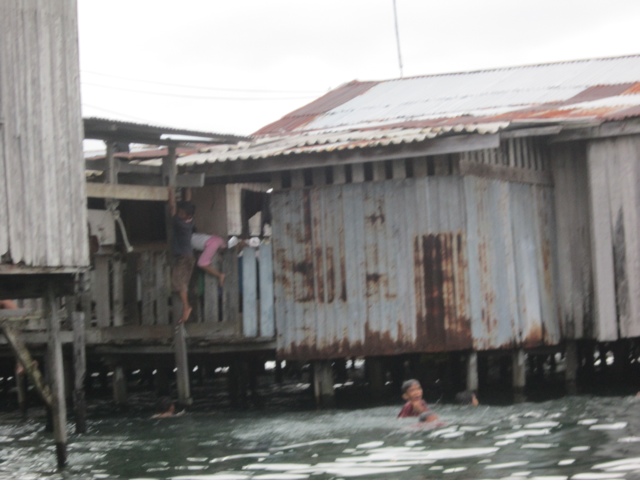
After a few days in the coastal town of Sandakan, Claire, Grace and a German (Danny) headed to a little island called Mabah. Close to Sipadan - a diver's Mecca. No one is allowed to stay on Sipadan. In fact you need a permit to snorkel or dive there. Only a handful can go daily and the permits get booked out months in advance. We stayed in a really friendly, very basic place in the water village. Most of the people on the island were originally from the Philippines. People have moved here for a better life. Tourists bring with them a lot of cash. Trade moves money around.
Aside from a sleepless night caused by a rat in our dorm attracted by the two tiny bananas I had squirrelled away in my bag, the bed bugs that feasted on me for two nights and the trigger fish attack that left a fellow snorkeler with a bleeding toe - Mabul was a fun few days. Our last night ended dancing on the beach with a group of work chums from Kuala Lumpur and a glamourous group of lady boys under an almost full moon. A moment from the road I will try never to forget.
Thailand escaped Empire and has therefore a unique culture combination of vibrant and tolerant that has seduced so many Westerners. In Thailand people consider that women are more intelligent than men. Friends who are looking to adopt here told me adopting a Thai baby girl is apparently close to impossible.
Bangkok was high tech, buzzing and glitzy. Much cleaner and more modern than I was expecting. In Bangkok I stayed with Steph who is another teacher in an international school and her partner James. Once again it was great to see a place through the eyes of someone who lives there. Steph took me to her local floating market. Hardly any tourists and amazing food. I tried little fried quails eggs with soy sauce, green pancakes with candy floss filling and scallops still in their shells. Buying food at local markets is what made me think about the power of trade to bring people together. Both buyer and seller benefit and despite little or no language skills a small connection is made.
Inspired by Thai food, I signed up for two Thai cooking courses. The first was with a lovely lady called Poo whose cooking school in her own community in the Bangkok slums had been financed with a loan from an Australian charity that provides micro loans to fledging businesses. An inspiring woman with a teenage son and on her second marriage she was the brains and the graft behind the slick operation that had kept is soul and brought cash to her own community.
From Bangkok I went north, with still not on the bike. The night train to Chiang Mai was an experience and a half. I had to buy a first class ticket - I had a room to myself. I quickly got to know my neighbours - Tony who had moved from the States to live in Thailand and a Canadian couple on holiday. I convinced my new friends to walk through the train - through staff compartments and sparking tracks to the restaurant car. Opening the door to this carriage was like opening the door to a secret club. Hit by the muggy breeze from the open windows - no air conditioning here, chincy Fairy lights, music videos and the loud buzz of conversation over the roar of the train. I joined Beatrice, a 59 year old artist from France and 20 something Augustine from Argentina for a beer. The night took a more surreal turn when a Thai police officer glugging rum with the best of them joined the group. What a night. And if I hadn't met Beatrice then perhaps I would not have been in the same restaurant as 'Javier', the Spanish cafe owner.
After a few days of coffees, markets and more amazing street food in Chiang Mai I decided it was time to get back on the bike and take on some of Thailand's mountains. The fact that Javier was staying in Pai was purely coincidence.
The ride would take two days. Easy enough I thought to myself.
The road out of Chiang Mai was flat. Easy cycling. And then I turned off to Pai and soon the hills began. Time to stop for a coffee. I probably, as usual, spent too long drinking coffee and didn't realise how soon it would get dark. The hill was incredibly steep and showed no sign of ending. I asked two fruit sellers how far to my intended stop and they said it was far. One tried to get on the back of my bike and I realised he was a bit the drunk side. I stopped at the next place advertising coffee and asked if they knew of any guest house. Owner, Chuchai said I could stay over the road in someone's house. He went to ask the man and he said his wife would be back at 7pm so I could come them. So far so good.
Chuchai then cooked me Chinese duck dinner and cracked open a special box of banana cakes he'd bought in Japan. Seven came and went but no sign of the lady opposite. Chuchai said that when his wife came home I could stay in their house. Everything was getting a bit strange. Eventually his wife came home with another man and two younger females. I slept on the sofa - one of five sleeping in the same room. After sampling one of Chuchai's perfectly timed 25 second espressos (he learnt how on google) I was back on the road to cycle the remaining rather tough 66 kilometres.
Pai is a small hippy town that turned into an even bigger attraction when two Thai rom coms were set here. It is on the backpacker trail so the local pool is awash with tattoo branded 20 somethings. There is also a well established artistic community comprised of Thai artists, musicians and a fair number of older American hippies who have moved here for the low cost of living. Others are drawn by the authorities relaxed approach to cannabis. In fact doing nothing in Pai has become a catch phrase for the place.
After several days of doing not much in Pai, apart from finding a regular breakfast spot, recognising and greeting the locals, swimming in two diifferent pools and eating some beautiful banana pancakes to celebrate pancake day I headed back to Chiang Mai. This time though on the back of a motor bike. Those 742 curves were so much easier with petrol.
One teacher, one chef, one bike, one moped ... who knows where the journey takes me next. Trade? Food? Or ...?
Http://twoteacherstwobikesoneworld.blogspot.com
It can be difficult to keep up with someone else's travels. In the last six weeks, since leaving Australia I have been around a bit so just to save any confusion - a summary:
I spent the second two weeks of January on the island of Borneo. My bike stayed in its box. The island is made up of three countries: Brunei, Malaysia and Indonesia. I stayed in Brunei and visited Sabah, in Malaysia. I then flew to Thailand and have been here almost a month. I have cycled for a few days. My decision to slow the trip down has led to less cycling, more trains and buses, less blog writing, a greater appreciation of Thai food, its markets and restaurants and spending time with some lovely people. I have come to the conclusion that three of the most important things that bring the world together are trade, food and love.
Brunei is a small oil rich country of 400,000 ruled by the Sultan. I stayed there with my friend Hilary who is a maths teacher at the international school. She and her husband Tony provided a home from home. Brunei is an interesting country. An oil rich dictatorship, the Sultan rules by decree. Until 1986 the country was a British protectorate. On the one hand Bruneians, as long as they are ethnic Malays, enjoy one of the highest standards of living in the world. They pay no taxes, have subsidised cars with very cheap petrol - people do not walk in Brunei - everyone drives on the highways that criss cross the country. People are also well looked after with state pensions. I met a group of Bruneian students on a day trip to the jungle. The students were sixth formers studying travel and tourism. Many of them planned to go to British universities, paid for by the Bruneian government before coming back to work in the oil industry. My friend Jaime's dad benefited from a similar programme though when he went to Britain he was not obliged to come back to Brunei.
I was interested in the nature of the dictatorship. It is certainly a strict Muslim country. You are expected to dress discreetly, no alcohol is allowed. Although you can bring in two bottles of wine and 24 beers every 24 hours so there is a culture of booze cruises amongst the expats. Recent decrees include no dancing and nothing is allowed to open between 12 and 2 on a Friday. Hilary and I were also surprised to read in the museum that circumcision is considered 'noble' for a woman. Baby girls are circumcised at 40 days. Female genital mutilation is defended by many and though not as extreme as the type performed in some parts of east Africa still a horrible practice, though done with good intention.
This traditional, family orientated and conservative culture means expats and rich Bruneians live a very separate life. I spent an afternoon lazing around the pool at the Empire Club. An opulent palace built by the Sultan's brother Jefri - the former finance minister - with public cash. Eventually a scandal meant the Sultan had to sack Jefri who avoided prosecution by turning over all his weath to the state. Even in a dictatorship the public have limits. Another interesting part of the expat life is the hash. A legacy of empire, the hash involves men running through the jungle, following a paper trail and ending of course with many beers. So very British.
Malaysian Borneo was quite a contrast from Brunei. I took a ferry to the island of Labuan and then another to KotaKinabalu. Here I met up with friends Xenia and Grace who just happened to be there at the same time. I also met Clare Cave. We had a great time travelling over the next week together in Malaysia. I use Claire's surname because she is a singer songwriter and has just released her first EP - In all good record shops (well on iTunes) now!
For my 10 days in Malaysia I felt I had joined the back packer circuit. This is where people come to climb mount Kinabalu, see Orangutangs, dive with turtles and treck in the leechy jungles. In one hostel I met Danny the German and Nico and Natalie. Nico was Australian and was cycling. Nico had for a long time been on a diet of only raw foods. I learned a lot about Malaysian fruit. The infamous sick smelling Durian may be the king but mangosteen is the queen with a regal purple exterior amd a small green crown, the fruit has a lychee, sweet and soft inside. Natalie his girlfriend was from Denmark and was training as a sex therapist. She said she helped people to 'first love themselves' but unlike some practioners was not one for practical therapies. A fruit expert and sexologist. What a combination.
Britain's Empire on Borneo grew through the trade of hard wood and rubber. Using elephants and Indian workers the British trading companies thrived. It is now palm oil plantations which dominate the landscape and threaten the rain forest and its inhabitants including Orangutans and the famous big nosed Proboscis monkeys. Despite quite a few tourists and its British history walking down the street or trying to communicate often generated much giggling from the local people. This took some getting used to but felt very adventurous even without the bike.
After a few days in the coastal town of Sandakan, Claire, Grace and a German (Danny) headed to a little island called Mabah. Close to Sipadan - a diver's Mecca. No one is allowed to stay on Sipadan. In fact you need a permit to snorkel or dive there. Only a handful can go daily and the permits get booked out months in advance. We stayed in a really friendly, very basic place in the water village. Most of the people on the island were originally from the Philippines. People have moved here for a better life. Tourists bring with them a lot of cash. Trade moves money around.
Aside from a sleepless night caused by a rat in our dorm attracted by the two tiny bananas I had squirrelled away in my bag, the bed bugs that feasted on me for two nights and the trigger fish attack that left a fellow snorkeler with a bleeding toe - Mabul was a fun few days. Our last night ended dancing on the beach with a group of work chums from Kuala Lumpur and a glamourous group of lady boys under an almost full moon. A moment from the road I will try never to forget.
Thailand escaped Empire and has therefore a unique culture combination of vibrant and tolerant that has seduced so many Westerners. In Thailand people consider that women are more intelligent than men. Friends who are looking to adopt here told me adopting a Thai baby girl is apparently close to impossible.
Bangkok was high tech, buzzing and glitzy. Much cleaner and more modern than I was expecting. In Bangkok I stayed with Steph who is another teacher in an international school and her partner James. Once again it was great to see a place through the eyes of someone who lives there. Steph took me to her local floating market. Hardly any tourists and amazing food. I tried little fried quails eggs with soy sauce, green pancakes with candy floss filling and scallops still in their shells. Buying food at local markets is what made me think about the power of trade to bring people together. Both buyer and seller benefit and despite little or no language skills a small connection is made.
Inspired by Thai food, I signed up for two Thai cooking courses. The first was with a lovely lady called Poo whose cooking school in her own community in the Bangkok slums had been financed with a loan from an Australian charity that provides micro loans to fledging businesses. An inspiring woman with a teenage son and on her second marriage she was the brains and the graft behind the slick operation that had kept is soul and brought cash to her own community.
From Bangkok I went north, with still not on the bike. The night train to Chiang Mai was an experience and a half. I had to buy a first class ticket - I had a room to myself. I quickly got to know my neighbours - Tony who had moved from the States to live in Thailand and a Canadian couple on holiday. I convinced my new friends to walk through the train - through staff compartments and sparking tracks to the restaurant car. Opening the door to this carriage was like opening the door to a secret club. Hit by the muggy breeze from the open windows - no air conditioning here, chincy Fairy lights, music videos and the loud buzz of conversation over the roar of the train. I joined Beatrice, a 59 year old artist from France and 20 something Augustine from Argentina for a beer. The night took a more surreal turn when a Thai police officer glugging rum with the best of them joined the group. What a night. And if I hadn't met Beatrice then perhaps I would not have been in the same restaurant as 'Javier', the Spanish cafe owner.
After a few days of coffees, markets and more amazing street food in Chiang Mai I decided it was time to get back on the bike and take on some of Thailand's mountains. The fact that Javier was staying in Pai was purely coincidence.
The ride would take two days. Easy enough I thought to myself.
The road out of Chiang Mai was flat. Easy cycling. And then I turned off to Pai and soon the hills began. Time to stop for a coffee. I probably, as usual, spent too long drinking coffee and didn't realise how soon it would get dark. The hill was incredibly steep and showed no sign of ending. I asked two fruit sellers how far to my intended stop and they said it was far. One tried to get on the back of my bike and I realised he was a bit the drunk side. I stopped at the next place advertising coffee and asked if they knew of any guest house. Owner, Chuchai said I could stay over the road in someone's house. He went to ask the man and he said his wife would be back at 7pm so I could come them. So far so good.
Chuchai then cooked me Chinese duck dinner and cracked open a special box of banana cakes he'd bought in Japan. Seven came and went but no sign of the lady opposite. Chuchai said that when his wife came home I could stay in their house. Everything was getting a bit strange. Eventually his wife came home with another man and two younger females. I slept on the sofa - one of five sleeping in the same room. After sampling one of Chuchai's perfectly timed 25 second espressos (he learnt how on google) I was back on the road to cycle the remaining rather tough 66 kilometres.
Pai is a small hippy town that turned into an even bigger attraction when two Thai rom coms were set here. It is on the backpacker trail so the local pool is awash with tattoo branded 20 somethings. There is also a well established artistic community comprised of Thai artists, musicians and a fair number of older American hippies who have moved here for the low cost of living. Others are drawn by the authorities relaxed approach to cannabis. In fact doing nothing in Pai has become a catch phrase for the place.
After several days of doing not much in Pai, apart from finding a regular breakfast spot, recognising and greeting the locals, swimming in two diifferent pools and eating some beautiful banana pancakes to celebrate pancake day I headed back to Chiang Mai. This time though on the back of a motor bike. Those 742 curves were so much easier with petrol.
One teacher, one chef, one bike, one moped ... who knows where the journey takes me next. Trade? Food? Or ...?
Http://twoteacherstwobikesoneworld.blogspot.com
Subscribe to:
Posts (Atom)